
Resilience, or mental toughness, is the ability to shrug off the difficulties that we encounter in life.
It is the ability to take a hit, or a hundred, and to walk it off.
It is the ability to withstand difficult things over an extended period of time.
Resilience is also a virtue and a hallmark of Stoicism.
Table of Contents
Open Table of Contents
Why Develop Resilience?
Resilience is an important virtue - one not often found in today’s overprotective world.
I wrote this article at the request of a friend who has been going through some tough personal times.
We have all experienced tough times, and it would be nice to have a systematic way to get through them in the future.
This is why resilience is important.
Resilience helps us develop a strong, internal frame of reference.
Examples of Resilience and Mental Toughness
What exactly does resilience or mental toughness look like?
If you run a business, it is putting out three major-level fires in a day… and then being ready to take on the fourth.
If you are starting up a new gig, it is making it through the desert of desertion where there is no reply from the market… but you know it’s coming.
Resilience is doing what we do and having the faith that our world will continue carrying on tomorrow, no matter how bad the circumstances are today.
It is being able to withstand those bad, personal circumstances and carry on with our emotions bearing down on us, rather than having everything come to a stop.
How Do You Practice Resilience Daily?
Resilience is a virtue.
This means it is something that you can strive to practice on a daily basis.
You know you have been resilient if at the end of the day you can say:
Wow, that was tough. But I made it. I kept things going.
How Do We Systematically Develop Resilience and Mental Toughness?
There are number of aspects to developing resilience.
Most of them involve your mindset, or inner game.
Think of it as aligning the arrows of your life in the same direction:
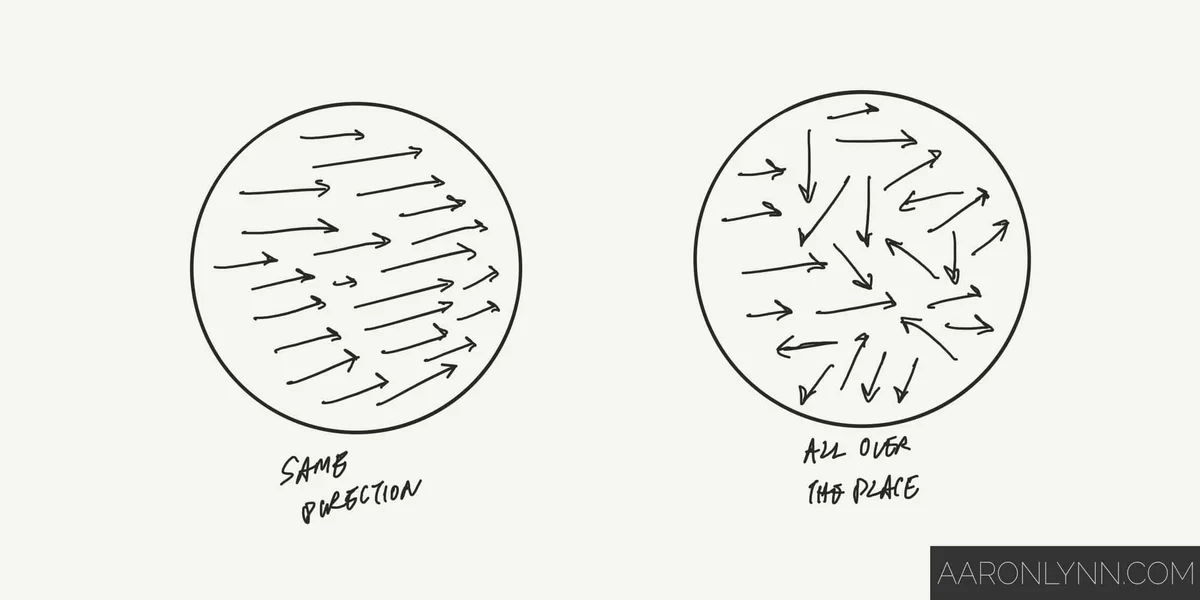
The more arrows there are that point the same way, the more resilient you will be.
Being Organised
Being organised helps you be more resilient.
The reason for this, is when things get tough, you can lean on your systems and structures and they can provide you with the resources to pull through.
Having Good Friends
It’s cliched, but good friends and a support network will help you become more resilient.
Like your personal systems, they can help you when sh*t hits the fan.
Useful Beliefs for Mental Toughness
There are number of beliefs that are useful in developing resilience and mental toughness:
-
Winning. The more you believe that winning and achieving your goals is a good thing, the more likely you are to push through when you encounter obstacles and setbacks.
-
Goodness. If you believe that the world is generally a good place full of good people, you are more likely to have the faith required to bounce back from temporary setbacks.1
-
“Whatever happens, happens such as you are either formed by nature able to bear it, or not able to bear it.” - Marcus Aurelius. Do not run from your pain or suffering. If you can take it, you will. If you can’t, you die. Either way, it ends.
-
Playfulness. In the modern day, nothing is ever so serious that it will completely end your/the world.
Mental Models for Resilience
There are also a couple of mental models that are useful in developing resilience.
The first mental model is the types of reality:2
-
There is subjective reality, which is what you perceive in your mind.
-
There is objective reality, which is the physical world that exists regardless of perception.
-
And there is intersubjective reality, which are things made real by collective belief - be they gods or money.
Being able to differentiate between the three types allows you to see difficult events from a different perspective, and helps you be more resilient.
The second mental model is to ask if there is something you can do about it.3
If there is something you can do to help the situation, do it.
If there is nothing you can do, there is no point worrying about it, as nothing can be done anyway.
Keeping this model in mind gives your rational mind a sufficient excuse to carry on.
A Plan for Developing Resilience
If we combine everything into a plan to develop resilience, here is what we would do.
We first would get organised. This means good planning and good goal setting.
We would remove as much negativity from our lives as possible, especially negative people.
We would strive for emotional mastery through being virtuous. And until we get there, we would use some emotional control hacks to help us catch emotions as they arise.4
We would tame our egos, through living virtuously.5
We would pick something in our lives to serve as a metaphor for developing resilience. This should be an activity that we can consistently do well in.
We would use that activity and our ability to succeed in it to develop our mental toughness.6
Lastly, we would ask ourselves daily if we have been resilient. Did we keep things going despite everything that happened?
What To Do Next
You can develop resilience and mental toughness.
It is just about having the right beliefs, doing the right things and trying to live as virtuously as possible.
The more virtues we practice, the stronger our resilience becomes. If we are self-disciplined, do the right things, act with persistence, focus and rationality, then our mental toughness goes up.
Remember - no situation is so unbearable that you were not made to bear it.
And remember that everything has an end - in completion, or in death.
Stay strong, stay resilient.
p.s. More on building emotional stability and reserve here.
Footnotes
-
Whether this is objectively true or not is a different matter. It is simply useful to believe it to be true. ↩
-
I first learnt about these from Yuval Noah Harari’s book Homo Deus. ↩
-
This comes from Stoicism. ↩
-
An example would be compartmentalising emotions by separating you, the emotion and what you have to do into three separate piles. ↩
-
Fragile egos are not resilient at all - they shatter and go off the rails. ↩
-
Sports are ideal for this. A good friend of mine uses his tennis game as his metaphor for mental toughness. ↩