
In 1985 at the Ford Motor Company’s Batavia transmission plant, project engineers made a surprising discovery.
At the behest of plant management, they had spent the last few weeks disassembling car transmissions made by one of their Japanese competitors and testing them - only to be stumped by what they found.
Even with the most cutting-edge measuring equipment available, all of the transmissions obtained from their competitor measured as virtually identical.
At first, the engineers thought it had to be a measurement error - they thought their gauges and tools were broken. So they called in a couple of instrument experts, only to learn there was nothing wrong with their instruments.
And so they investigated further and what they discovered shocked them. The Japanese parts were 200% more precisely engineered at the micron level than their own.
It turns out that all the transmissions procured from Japan were so well-manufactured that the most precise measuring tools at the time could not tell the difference between them.
Table of Contents
Open Table of Contents
What is a Standard Operating Procedure?
A standard operating procedure is a structured document that outlines a series of steps that someone can undertake to produce a predictable result, most of the time.
As the Ford story demonstrates, it was originally used in manufacturing. Today though, it is widely used in a range of modern businesses, from creative agencies to service firms to information-based companies.
Why are SOPs Important?
Let’s start with the most important reason: if you have a process that you know produces a standardised result, by improving that process, you can improve the quality (or efficiency) of that result over time.
Like this:
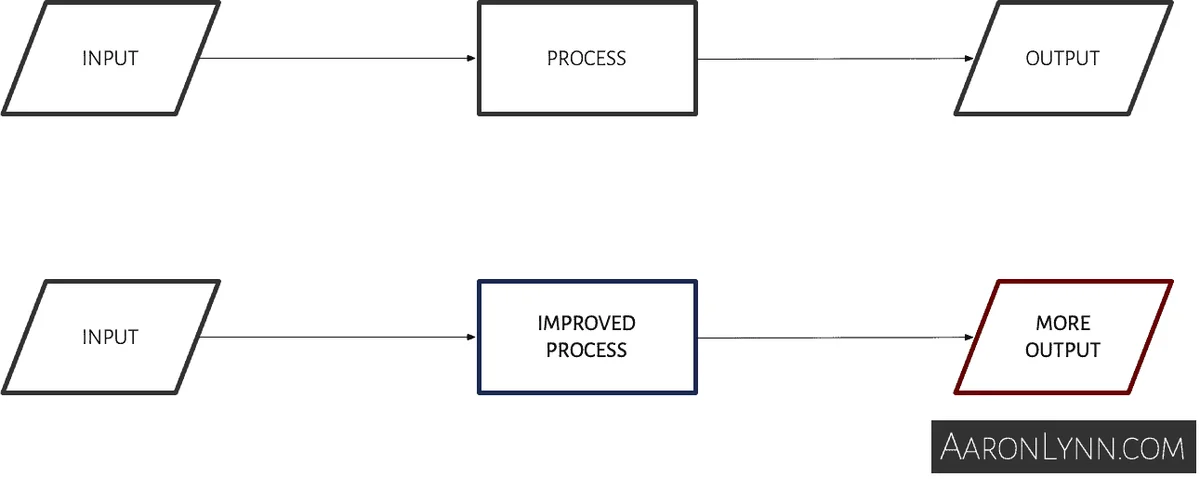
Input, Process, Output
Here are some more reasons:
-
Deliver quality uniform results. This means better output for customers and stakeholders.
-
Reduction in costs or processing time.
-
Economise (maximise) inputs, be they material, labour or time.
Here are some less obvious reasons:
-
The ability to train new team members, fast.
-
The ability to better allocate resources and team members based on knowing how certain processes will be done.
-
The easiest way to “work on” your business instead of “working in” your business.
-
Automation/AI deployment opportunities.
And of course, the big one mentioned earlier:
The ability to measure and improve processes over time.
How to Create a Standard Operating Procedure
Writing a standard operating procedure is actually straightforward. Here is the format that I use for companies I have worked with:
- Title
- What
- Who
- When
- Process
- Results
Let’s break this down a bit.
The title is the name of your procedure. You want this to be searchable and easily understandable so that everyone on your team immediately knows what it is. Examples:
-
How to greet walk-in clients.
-
How to colour correct iPhone photographs.
The what is a 1-2 sentence description of what the process does, beyond the title. Sometimes the title is sufficient, other times it needs to be placed within a context, especially if the procedure is part of a larger process.
The who is simply who performs the procedure. It could be you, anyone, or it could be a particular department within your company.
The when is the moment of time or step in a larger process where this procedure is performed. It could be date-based, such as the first of every month, or process-based such as “after XYZ procedure has been completed”.
The process is the sequence of minimum, common steps for completing the task to deliver the desired results. This is the main part of every standard operating procedure, should be numbered and sequential, and should include as much detail as needed for the person reading the procedure and using it.
You can use subheadings, bullet lists, diagrams, screenshots and even video to demonstrate the process.1 You can also link to external resources.2
It is useful to write the process with the mindset that nothing is too ludicrous to include within the process, so long as it helps the user complete the process successfully. Make procedures as detailed as needed, but as simple as possible. They are only useful if someone actually uses it.
The results are what should happen once the standard operating procedure has been completed. These should be specific, measurable and in line with the business (or personal) objectives.
Using SOPs in Business
Here’s a mini-SOP process for how to use a standard operating procedure in a modern knowledge or service-based business:
-
Write the standard operating procedure.
-
Store it in a central location where it can be easily accessed. I recommend something like Confluence or Notion.
-
Train team members in its use. Team members who are switched-on will see its immediate value and have little or no objection to using a standardised process.
-
Give team members the authority to modify it as they perform their tasks, so long as results are being improved.
The last step is especially important and is what makes standard operating procedures worthwhile - the ability to incrementally improve them over time, to deliver better results for your business and your clients.
Tip: Your SOPs will be sub-processes of your critical or core processes.
Using Standard Operating Procedures in Your Personal Life
A common question that I get from friends and acquaintances is, “Aaron, I know you’re into all that systems stuff… but do I need “standard operating procedures” in my personal life? It seems kind of… rigid.”
And my answer to that is, “You already have procedures in your personal life. You just call them habits.”
Habits are just things you do regularly in a certain way. Whether they are good habits (like exercise) or bad habits (like smoking), we all have them and do them.
So is it worth writing a full “standard operating procedure” for something that you just regularly do?
Well, it depends:
-
If it’s something you already do well, then no.
-
If it’s something you want to start doing (or perhaps stop doing), then yes.
-
If it’s something you want to improve, then maybe.
It can be extremely useful to have a standard set of steps written down to reference when you’re trying to establish a new habit. But once you have the habit “in memory”, you can discard the steps and just run on instinct.
For example, someone recently asked me: “How can I consistently get to the gym three days a week?”
And the answer is simple: you write down a standard operating procedure, and follow it until it’s a habit.
Here’s that very example, written out:
Title:
How to Get to the Gym Consistently

Who:
Me

What:
Making sure I go to the gym every Monday, Wednesday and Friday before work.

When:
* Go to the gym every Monday, Wednesday, Friday morning.
* Prepare all my gym gear on Sunday, Tuesday and Thursday nights before going to sleep.

Process:
1. On Sunday, Tuesday and Thursday night, pack my gym bag with:
* Bag.
* Towel.
* Chalk.
* Water.
* Earphones.
* Phone.
* Gym membership card.
2. Lay out my:
* Gym clothes.
* Shoes and socks.
3. Put my gym bag in the car.
4. On Monday, Wednesday and Friday morning, put on my prepared gym clothes, shoes and socks and leave home on the dot at 7am and drive to the gym.

Results:
* Zero friction on gym day mornings.
* At the gym every Monday, Wednesday and Friday morning, except under extraordinary circumstances.
You can take this procedure, print it out (or put it on your phone) and run with it for however long you need to, until you start doing it automatically, at which point it has become habit.
The Most Common Objection to Standard Operating Procedures
The most common objection that people have to “standardising” things is that it’s too robotic, too routine, and that it stifles creativity.
There’s a great quote from Verne Harnish regarding this:
Routine sets you free.
What he means is that by having routines, procedures, and structures in place, you free up your time from all the boring, easily-standardised humdrum and create time and space to focus on the creative, customised work.
For example, in a service business each client’s case may not be able to be standardised… but client setup and billing most definitely can be.
What To Do Next
In many ways this article in and of itself is an example of a standard operating procedure.
The who is you, the what is writing standard operating procedures, the when is now, and the process is the process outlined.
I hope the result is that you take what you have read and write your own standard operating procedures - most definitely for your business, and perhaps for a habit or two in your personal life as well.
To help you get started, download my Standard Operating Procedure SOP here:
You can use this yourself, train your team in how to use it or simply as a template for creating your own SOPs.